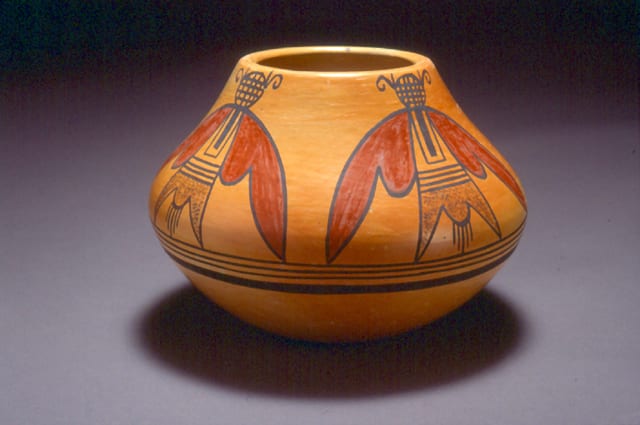
There are quite a number of pots with butterfly designs in this collection. (See “Category” listing.) This was purchased first. For a gentle discussion of the meaning of butterflies and flowers in Hopi culture, see Hays-Gilpin (2006:12-25).
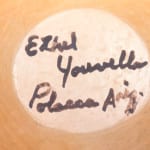
A niece of Grace Chapella (1991-10 and 1993-01), cousin of Mary Ami (2002-05), and Mother of Verna Nahee (1983-02), she was born in 1919. Shortly after the publication of his “7 Families in Pueblo Pottery” book Rick Dillingham organized a pueblo pottery show at Dewey-Kofron Gallery (Santa Fe), where he was employed. The catalog for the exhibit is simply a listing of comments by the pueblo potters represented. Ethel said:
“I learned it [pottery making] from my grandma, Lela Augh (Preston) when I was about 6 years old [about 1925]. I’d make little things and she would go over them for me. I’ve been making pottery steadily since the 1950’s. Some of the designs come from my grandma and I picked up some from the old pieces at the ruins. Some I make up myself. I figure out the shape before I begin, but some change while I’m making them. Some of the small ones get bigger and bigger. You can easily tell Hopi pottery from the Tewa. I don’t know why, but I can always tell. I’ve entered the Flagstaff Pow-Wow for the past couple of years and have won some ribbons. I’ll continue to send them there.”
—-Exhibition October 8 to October 24, 1977. Exhibition catalog unnumbered.
I assume that the “Flagstaff Pow-Wow” Ethel mentions was the annual Jul;y 4th weekend Hopi Show at the Museum of Northern Arizona.
I purchased a second pot from Ethel in 1998 and gave it to my daughter Rebecca as a gift. For a short biography of Ms. Youvella, see Collins (1977:23). She discussed how she learned to pot and is pictured in Dillingham (1994:13). Bill and I spoke with her in January 2005 at the community center in Sichomovi near her home; she was a kind, attractive woman. She died the following year.
