
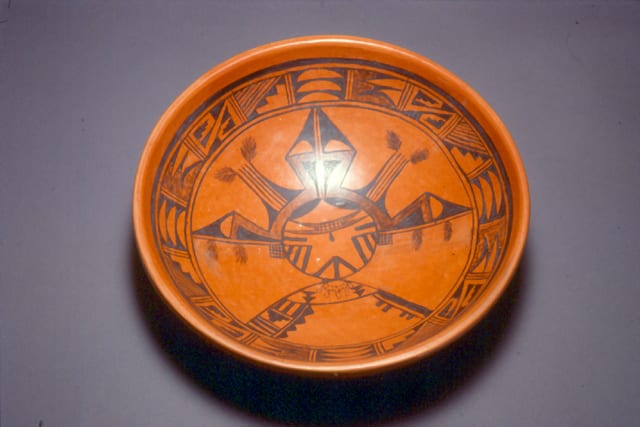
Hopi red-ware bowl, Shalako Kachina (“Corn Maden”) on interior by Beth Sakeva (attributed).
Purchased at the Museum of Northern Arizona, but the museum was unable to identify the maker since the shop manager kept poor inventory records (inventory # M9505 on bottom). Based on the “style of design,” Rick Dillingham suggests that this pot was “Possibly made by Beth Sakeva.” Bruce McGee, long-time owner of the trading post at Keam’s Canyon, looked at a picture of the pot and wrote (7/3/92): “The plate is a good example of Beth Sakeva’s work. It is a design that she loved to do and do well. There is no question that it is hers. Rick does know his pottery and has advised you correctly.”
Ms. Sakeva was one of the potters honored in the 1977 Grace Chapella show in California organized by John Collins. (1977:20). According to Collins, Beth was born in Tewa Village (Hano) on December 4, 1926, She moved to Winslow as a married woman, but moved back to Tewa Village with her three children after her husband died. She learned to make pottery from her mother (Hazel Shula) about 1971, when she was 45 years old.
“At first she could form and shape the pieces, but could not paint or fire them. Only for the past four years [since 1973] has she really been working on pottery-making and performing all the steps in the process. Practically all of her pottery is red…[For decoration] she uses the Corn Maiden kachina face and headrest design which she learned from her mother, but which she alters to suit her own aesthetic sense. Her designs and workmanship are distinctive and easily recognized as those of Beth Sakeva (Collins,1977:20).”
Shortly after the publication of his “7 Families in Pueblo Pottery” book Rick Dillingham organized a pueblo pottery show at Dewey-Kofron Gallery (Santa Fe), where he was employed. The catalog for the exhibit is simply a listing of comments by the pueblo potters represented. Beth Sakeva said:
“I live on the Hopi Reservation and I am a Tewa. I learned to make potteries around 1966, not very good because I was just learning. I finally learned all the steps in pottery making. Our pottery is different. You can tell a Hopi pot from a Tewa pot. My mother (Hazel Shula) used to draw the Corn Maiden on her pottery and I learned from her. My other designs I guess just came into my head. I just started using the corn figures about a year ago. I hope the growing Tewa girls will keep up and learn to make potteries. We all make our living from it. I am very thankful for the people who buy our wares.”
—Exhibit October 8 to 24, 1977. Unnumbered pages.
Apparently Beth began to make pottery about 1966 but became more focused on the process 7 years later. The design on bowl 1987-03 matches Collins’ description of a typical Beth Sakeva design as well matching the design referenced in Beth’s own comments. The colors on pot 1987-03 are typical of Sakeva’s work and are very close to the color of ancient Tsegi Orange Ware vessels (Bartlett, 1977:3). She now signs her pots. Since this is large and unsigned, I’m guessing it is an earlier pot of hers, perhaps made in the 1970s. For a somewhat similarly- designed bowl circa 1900, see Dittemore (1990:56). Pot 1986-04 signed “A. Sakeva” was made by her son, Alfonso.
