
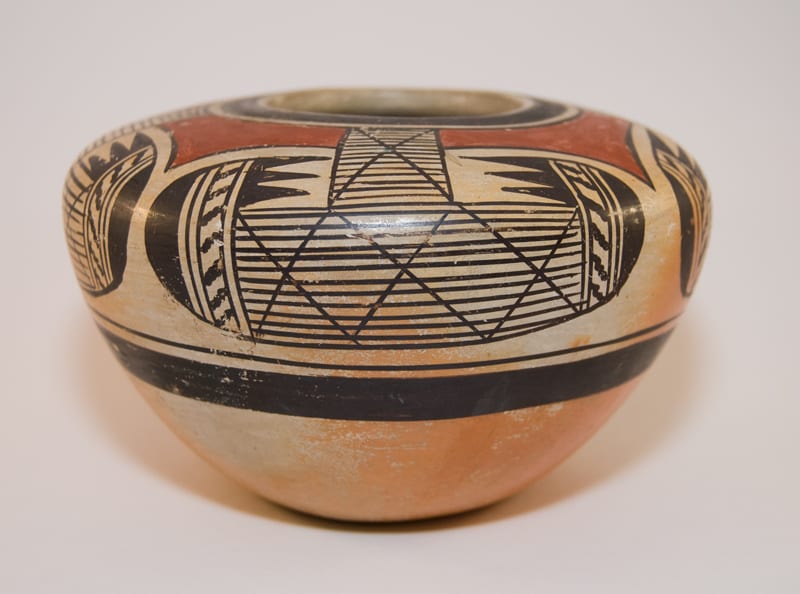
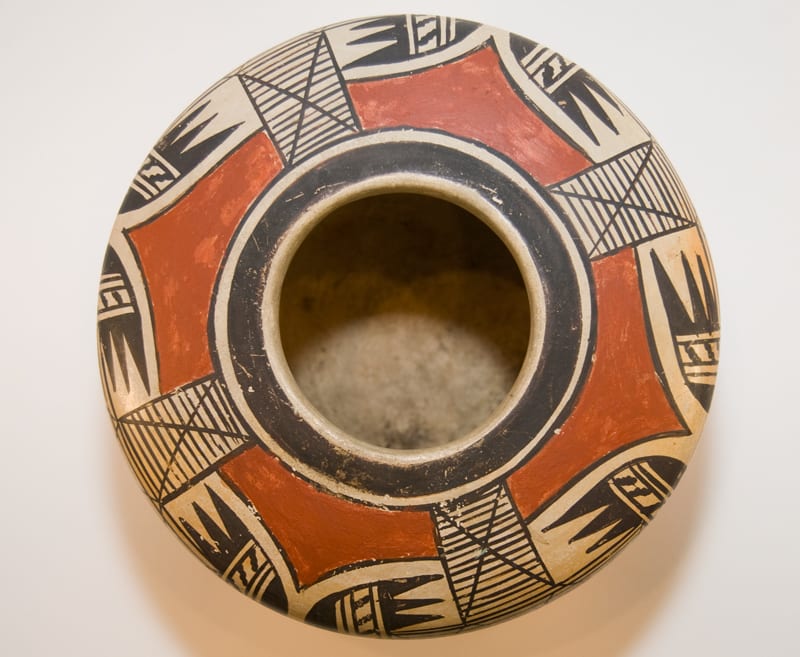
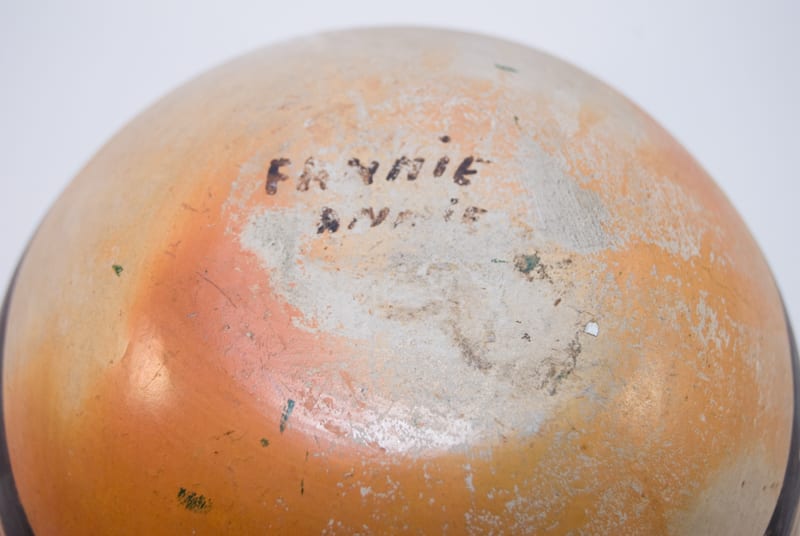
The batwing design was used by Nampeyo and became a classic Nampeyo family design. In my opinion, this batwing design was the most elegant design painted by Fannie. [For another batwing jar painted by Fannie, see 2009-14.]
Annie was born in 1883; her daughter Rachel was born in 1900. Fannie was probably born the same year as Rachel. Thus, although Annie and Fannie are sisters, there is a generation of age between them. Although it has long been known that Fannie painted pots formed by her mother (cf. 2007-12), this is the first pot that I have seen where Fannie painted for a sibling. Such cooperation is not reported in the literature, though it is not surprising. (See McChesney 2003.)
After about 1915, when Nampeyo became functionally blind, a variety of female relatives painted for Nampeyo, who continued to form pots. Sometimes these pots were signed with a version of the name “Nampeyo.” Sometimes the name “Nampeyo” was written above the first name of the painter. These pots are listed on this website as “Nampeyo 3.” Appendix E details the history of these signed Nampeyo pots. Most of these collaborative pots are rather crudely-formed and routinely-painted. Pot 2008-01 is exceptional because it is both well-formed and carries a careful, elegant design that perfectly fits the pot.
See “Bat Wing Design” in the Category List for a complete listing of pots in this collection using variations of this design.
A photograph of Nampeyo taken in 1934 by Mrs. Williams is reprinted in Messier & Messier, 2007:35.
