
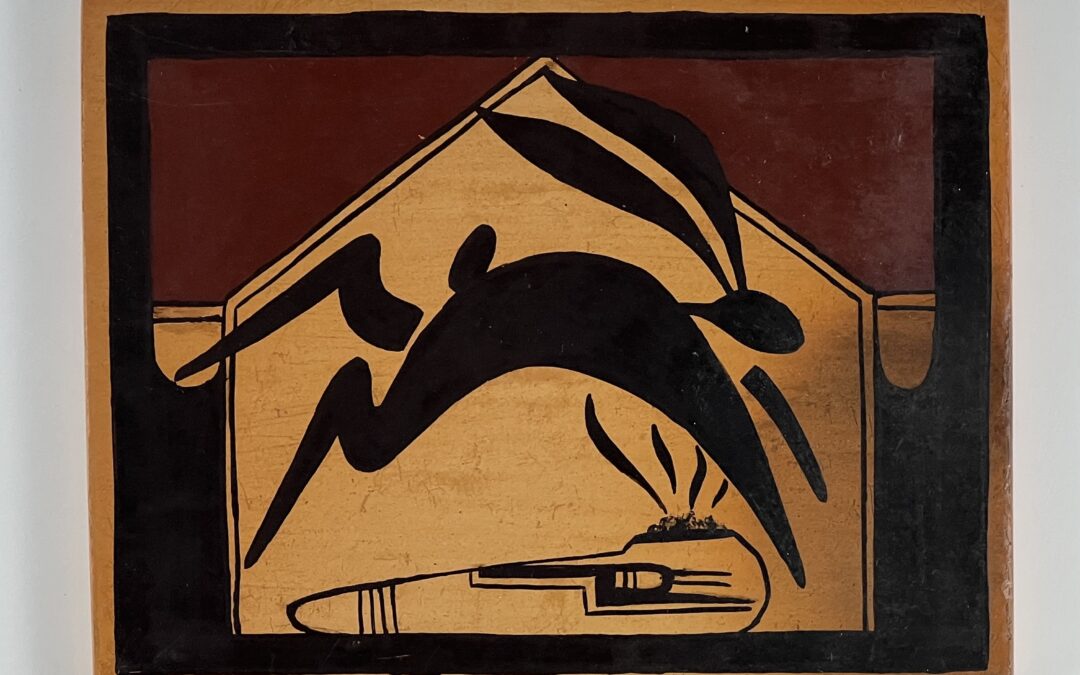

This is the second tile in this collection by Logan Koopee. The first (2009-26) was purchased directly from him at his brother’s home in Walpi, First Mesa. Logan is primarily a painter, and his skill is clearly shown in the elaborate and detailed painting of a dancer on the earlier tile. Tile 2025-08, discussed here, carries a simpler image, almost a shadow silhouette, but is more energized than the first tile. The intention of the design on the earlier tile is clear. The images on tile 2025-08 are clear, but the intention enigmatic.
Form:
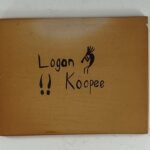
This rectangular form is completely flat, a notable achievement event since flat wet clay tends to curl when it dries. The rear of the tile has a rich, variegated, golden blush from the outdoor dung firing. The unpainted sections on the front have a more uniform, flat pale color, except that the lower right corner of the tile shows a dark smudge from the firing.
As on tile 2009-26, the rear of the tile is boldly signed with Logan’s name in printed letters, with the addition of a finely-drawn Kokopelli figure and two curved elements that form the imprint of a deer (?) hoof.
Design:
An unpainted form in the shape of the profile of a house defines the center of the tile. Resting on each side of the slope of its roof are large maroon triangles with their lower point truncated. At this truncated point there are two parallel lines (forming an unpainted “one-lane highway”) and suspended from this highway are unpainted tubular forms with rounded ends. A disrespectful summary view of this arrangement is that we are looking at the profile of a house with rain gutters and with something square and maroon on it roof.
All of the design is black, except for the large maroon “tabula” resting on the roof of the house. Counting the unpainted surface of the tile as a pale tan, the tile displays three colors.
The two designs enclosed by the house provide the central interest to the painting. On the floor of the house is a fat smoking pipe 2.875-inches long and 0.75-inches high. Four parallel lines near the bit form a 3-lane highway. Much of the rest of the pipe is decorated with a 1.75-inch idiosyncratic design that looks like a handled implement with spikes at its end. The bowl of the pipe is piled high with a burning material, its smoke represented by four leaf-shaped wisps.
The central image and focus of the tile is the silhouette of a rabbit shown leaping into the house. The core of the image is the large crescent form that incorporates the rabbit’s torso and right front and right rear legs. The rear left leg is slightly separated from the crescent core. The end of this leg obscures a wall of the house,The left front leg is a simple thin form also separated from the torso and set below the head. The rear legs are marked by a sharp curve at the knee; the front legs are slightly curved. Large leaf-shaped ears sprout from the small oval head. An oval tail adorns the rear of the torso.
Design Analysis:
The rich colors of maroon and black contrast with the unpainted surfaces giving the tile a rich look.
The four leaf-shaped wisps of smoke have the same form as the leaf-shaped rabbit ears, helping visually unify the design.
Note that left rear leg of the rabbit slightly obscures the wall of the house. This small detail adds greatly to the power of the image since it indicates that the rabbit is in front of the structure and is jumping into it. Thus a depth of focus is added to this flat tile. This same device was used by Mark Tahbo on canteen 2018-01 to indicate a roadrunner passing into the underworld.
The house and surrounding color is stolid and static. The rabbit jumping into the house is a sharply contrasting image with great motion. The detailed image of the lit pipe below is intermediate to these other shapes: more energized than the house around it but less energized than the rabbit over it. Together, these three levels of design work together to produce a design that is centered, attractive and energized.
I do not understand much of the symbolism on the tile. The pipe is the symbol of the tobacco clan and was used by members of that clan to mark their pottery (cf 2015-01). However, Logan is a descendent of Nellie Nampeyo, and thus a member of the corn clan. The tile is signed with two symbols in addition to a name. The Kokopelli symbol was also used by Jake Koopee, Logan’s famous brother. The two other marks, I believe, are the imprint of a deer’s foot. This symbol is used by some members of the Navassie family when signing pottery to indicate their clan, but I do not know why Logan included it on this tile as well as the earlier tile by Logan in this collection (2009-26).
The design is clear but enigmatic. Why a house? Why a large lit pipe in the house? Why a rabbit jumping into the house over the pipe? Is this just a collection of random images or does it contain some meaning? I have no idea, but the format is intriguing. Many —probably most— tiles from Hopi depict the dramatic Polik’Mana image. Most of the remaining are filled with patterns of abstract Sikyatki Revival elements. Tile 2025-08 displays an abstract, modern design that distinguishes it from other tiles from Hopi. That makes it a unique enigma.
