
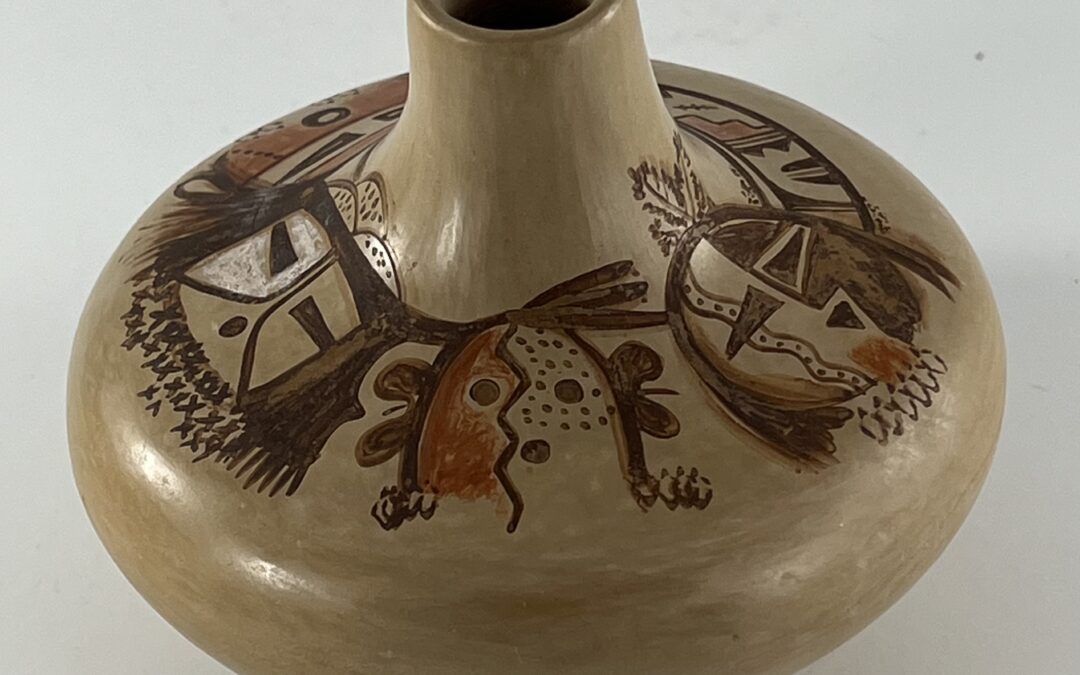

The neck is 1.125-inches high.
This is a graceful but clunky jar with an inventive, engaging design. Its maker was a brilliant, iconoclastic artist adept in many mediums.
Randall Sahmie (1950–2008) was the fourth of eight children of Priscilla Namingha Nampeyo. His mother strongly encouraged his four sisters to create pottery using the designs made famous by their great-great grandmother. Randall, however, seems to have had a particularly exuberant spirit. creating oil paintings, carved kachinas, and pottery following his own internal muse. The four Spirit Beings depicted on this jar are a product of his imagination.
Form:
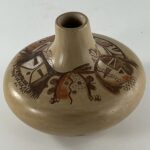
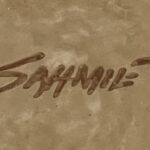
While this small jar has a particularly graceful shape, it is strikingly heavy for its size. Much of this weight seems to be in its thick base. From a 1-5-inch base the surface curves upward 2.0-inches to the waist, then turns inward another 2-inches to the neck. The clay fired an even tan without blushing. It is signed on the bottom SAHMIE, in capital letters.
Design:
The design consists of 4 faces plus a linear strip of geometric elements. The faces fill about 75% of the circumference of the jar:
- A round red face with an unpainted mask shows two triangular eyes. The nose is a simple circle; from the cheeks hang two bundles of pathos, prayer feathers. The right cheek (viewer’s perspective) shows a dotted line. The top-knot of hair has four projecting springs of hair with additional hair hanging down on the sides of the head. The right ear has a large pendant earring.
- A square face has eyes set within borders, leaving only an uncovered section around the mouth and a thin uncovered strip between the eyes. The left eye is a stubby black triangle; the right eye triangle lacks a point. The mouth is a simple black dot. Three doted half-leaf shapes form a low tabula above the head. A bang of short hair marks the forehead with cascades of longer hair covering the ears. Stippling around the neck might represent spruce boughs.
- This face is shaped like an inverted “U” with a hairpiece of 4 large feathers attached to the apex. The hair appears to be gathered into maiden whorls. The face is vertically divided by a wavy line, with the left half colored red and the right half stippled. Large dots represent the eyes and nose. There are wispy small decorations on either side of the neck.
- This off-round face is the most complicated on the jar. Detailed feathers provide a top-knot; long hair flows evenly down the head. The face is divided into a white left half and a blotchy, darker, right half except that the white half incorporates the triangular mouth, thus intruding into the darker half. The eyes are long, black isosceles triangles. A snake-like stippled form undulates down the middle of the white face. A small red patch colors the chin of the white face; a sequence of small diamond shapes forms a net below.
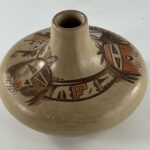
A thin linear strip of geometric designs organized into three sections runs about 2.75-inches between the first and last heads. Its upper and lower borders are a thin lines, except that a casually-applied second line has been added to the top border. One red element highlights the design in the middle section; other elements are drawn with muddy black paint.
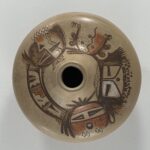
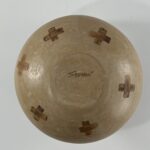
Six broad-stroke “Spider Woman crosses” mark the bottom.
Design Analysis:
The 8 other ceramic items by Randall in this collection are well-made. Jar 2025-15’s thick bottom and clunky feel is an exception to this pattern. The low-slung body with a tall neck is an unusual shape, as are some of the other Randall ceramics (cf 2015-09).
The six broad crosses on the bottom are similar to a traditional design on some Navajo rugs.
The crowd of Spirit Being faces on the jar is striking. I find each Being complex and engaging. The band of symbols throws the design off-balance and gives the jar energy. Notice that the lower edges of the faces are left open so that the design seems to spill over the edge of the jar.
For many years Janice and Joseph Day ran Tsakurshovi, a supply shop for Hopi artists and a trading post on Second Mesa [American Indian Art Magazine, 32(1) 58-65, 92-93]. I asked Joseph if he could identify the katrina’s on jar 2025-15 and he replied:
“I think the spirit images on your new acquisition are the product of Randall’s imagination or perhaps Tewa spirit images….In either case, it’s a great little piece. The one on the bottom in the pic on the right is female, some kind of maiden based on the butterfly hair do.”—Email (1-19-26)
The spirited Beings on this jar radiate the vibrant aesthetic of their maker.
Randall died in Winslow, AZ, shortly before his Mother’s death in 2008.
