
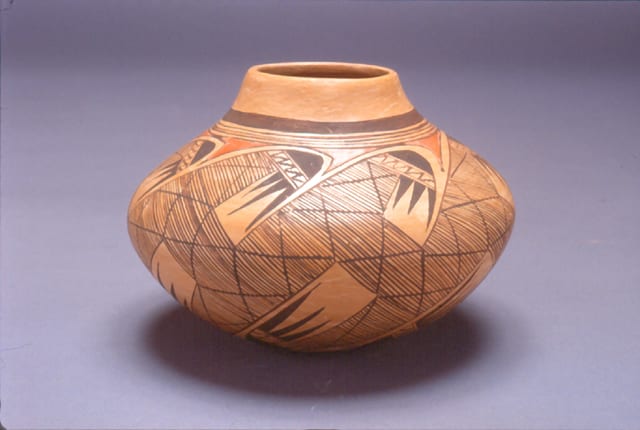
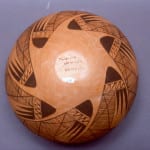
Hopi pot, “fine-line migration design,” by Priscilla Namingha (Nampeyo), one of Rachel Namingha’s (1924–2008) five children. Made about 1970.
This is a very fine-line rendition of a traditional “Old Lady” Nampeyo design, itself derived from an Anatovi Pueblo design of the 1300s. See the article about Priscilla, with good pictures of her and a similar pot, in ACA Galleries (1980:22-24). Compare this pot to other pots in the collection with the “Fine Line Migration” design (see Category List). This rendition by Priscilla is not as precisely drawn as some others, but this gives the design a special power and energy. For another picture of Priscilla and her comment about the difficulty of doing this fine line design, see Barsook (1974:39-40) and the quote below. See also, her picture and comments in Dillingham (1994:45). Another Priscilla fine line pot is pictured in Adobe Galleries (1983: 3, #4). For other pottery by Priscilla, see the Artist List.
Shortly after the publication of his “7 Families in Pueblo Pottery” book Rick Dillingham organized a pueblo pottery show at Dewey-Kofron Gallery (Santa Fe), where he was employed. The catalog for the exhibit is simply a listing of comments by the pueblo potters represented. Of pottery making Priscilla said:
“I learned when I was in my 20’s [the 1940’s], not really good, just starting. I really began to work when I was my 40’s [the 1960’s]. I used to not be interested. The designs are very complicated and I thought I’d never learn. I decided to settle down and work on it. The fine designs are very confusing. Once I learned to put it on it became easier. I just had to learn it myself.
I’ve taught my daughters. I get them through school with my potteries. I told them it was hard to make a living when you don’t know how, so i taught them how to do it. I tell them to keep up with it no matter how poor some turn out. I used to paint for them. Now they do it themselves. I keep checking. They do it all themselves.
I used to get pieces from [the ancient village site of] Sikyatki. They looked like my great-grandmother’s (Nampeyo) and I’m glad she used them. Now I can do the same thing. I copied all the painting she did. Sometimes they don’t come out right, but they look good to me. I’m still doing the same traditional designs that I like. The marks from the fire don’t make me feel bad. They don’t make a pot bad. I’m proud that I can do it all by myself; mold it, paint it and fire it. It’s my hands that make the pottery, and the One who’s taking care of us is the One who’s helping.”
—-Exhibit October 8 to 24, 1977. Catalog pages unnumbered.
I believe the “fine design” that Priscilla refers to in this quote is what is now referred to as “the migration design” and is the design on jar 1991-05.
