
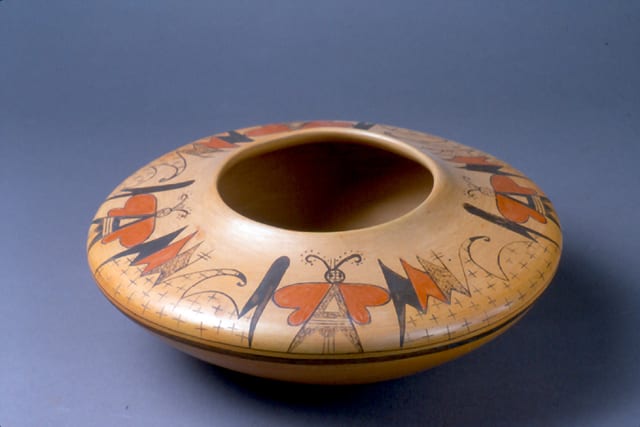

The painting is not perfect and was done in the mid-1980s, when Mark (who was about 26 years old) had not fully developed his talent.
Shortly after the publication of his “7 Families in Pueblo Pottery” book Rick Dillingham organized a pueblo pottery show at Dewey-Kofron Gallery (Santa Fe), where he was employed. The catalog for the exhibit is simply a listing of comments by the pueblo potters represented. Alma Tahbo, Mark’s grandmother, spoke of Mark and he added his own comments:
“Alma: Mark has been doing pots for 2 or 3 years. He got interested watching us work. …
Mark: I haven’t been potting long and I learned a lot on my own. I am very thankful that she (Grace Chapella) is still here and that I am carrying on her design. I hope to carry on and be a success with my pottery. I don’t think I’ll ever part with this design.”
——Exhibition October 8 to October 24, 1977. Pages unnumbered.
The design Mark refers to is the “Siitalpuva,” life bursting into being design after a Spring rain. Grace made it famous and Mark frequently used it during the first few years of his pottery-making. It is the design on jar 1995-01 and is a rendition of an ancient Sikyatki design.
For a butterfly jar by Grace that is part of this collection, see 2010-22. For Mark’s interpretation of the meaning of this design, see the catalog entry for the Grace pot.
Commenting on another Mark Tahbo made about the same time as 1995-01, Alan Hayes wrote: “Mark’s work in more recent years is quite different. It features more mechanically precise painting. The freer style on this jar has a different, warmer appeal and lets you feel a closer connection with the artist’s hand.” I agree.
For a similar pot by Mark, done in a more casusal “folk” style, see 1997-08. For another similar pot by Mark’s sister Dianna, see 1992-06.
For other pots with butterfly designs, see the Category List.
