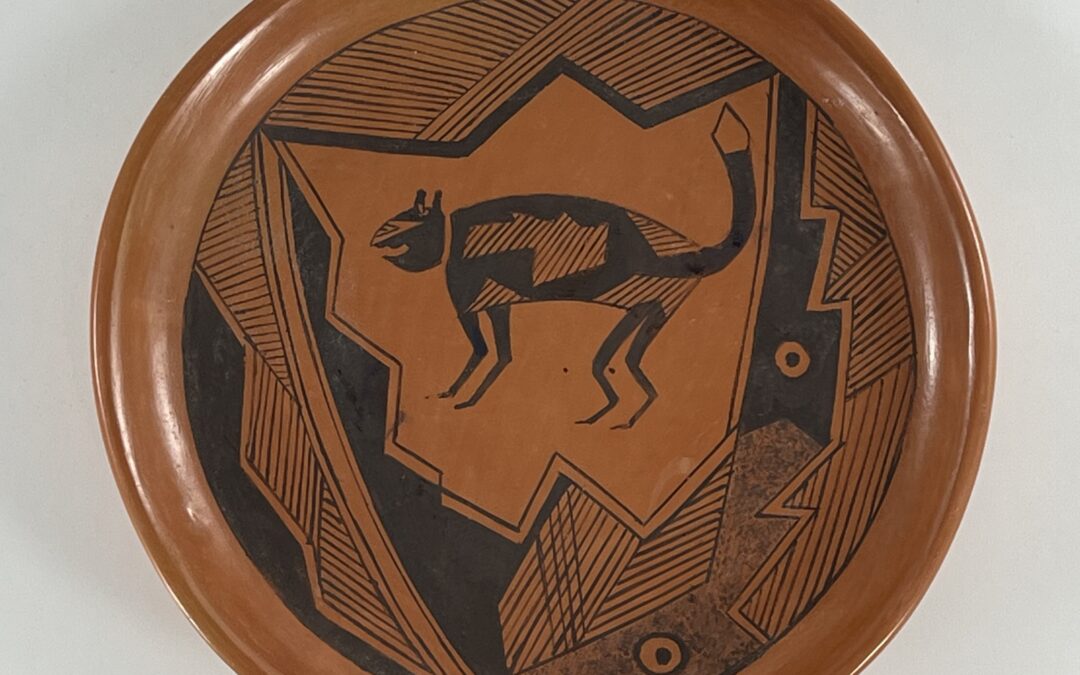

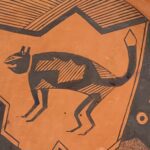

Black-on-red monochromatic pottery from Hopi is unusual, but not rare. Quadrupeds depicted on pottery are more unusual. The framing of this creature by almost 2 dozen variegated surfaces effectively highlights the folky animal, which might be a mountain lion. The design reminds me of a petroglyph on the irregular surface of the cliff at Dinnebito Park on the Hopi Reservation.
Form:
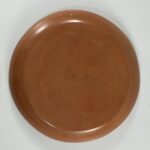
The plate is perfectly-formed, round and flat, with a 0.5-inch rim. Presumably polished with a smooth stone, the surface does not show any of the usual polishing striations.
“Sikyatska,” yellow clay that fires red, is more difficult to form than the grey clay generally used at Hopi. Though sometimes used to form pots, sikyatska is more often used as a slip to cover the grey-clay underbody. Usually a red pot has enough chips or wear marks that I can determine if the red surface is a slip or the color of the underbody clay. No such blemishes mark this plate, so I am unsure whether the surface color is a slip or is the clay body.
On the back, the plate is scratch-signed “L.C.N.” with the image of a corn stalk.
Design:
The design is contained in a 5.5-inch-diameter thin black circle at the center of the interior. All the decoration is done with black paint with variation created by different patterns of both form and internal design of the sections, plus 2 round eyes.
At the center of the plate is an irregularly-shaped unpainted area. At the center of this space is a fierce creature. The unpainted center is edged by a patchwork of 22 irregularly-shaped forms that surround it. Let’s start at the parameter and work our way toward the center of the plate.
Of the 22 shapes in the parameter, four are solid black, two on the left side of the plate and one on the right side. Across the top of the central open space is a zig-zag black stripe and 3 additional unpainted stripes complete the circumference of this irregular open space. Four curved lines form an unpainted 3-lane “highway” on the left side of the plate and 2 parallel and both stepped and zig-zag lines form an unpainted 1-lane highway on the right side of the plate. Ten of the shapes are filled with parallel lines, variation being created by embedding these lines within triangular, diamond and irregular forms. One of these forms is rectangular with one pointed end and the parallel lines it encompasses are crossed by 4 parallel and slanted lines forming a crosshatch pattern. One long irregular section starting at the bottom of the design and reaching upward is stippled. Embedded in this stippled section and the black section above it are small, unpainted, circles with a black dot in the center: eyes.
The creature at the center of the plate is composed of an additional dozen irregular forms confined within the animal outline. Much of the head, both sets of legs, the majority of the body and almost all of the tail are black. At the center of the body, however, is an irregular form that is filled with parallel lines, as are small areas above both the front and back legs and a patch above the base of the tail. A triangular area around the eyes is unpainted, creating a mask-like visage. The eyes are defined by a triangular line enclosing a black dot set inside the larger triangular mask. The tip of the tail is also unpainted. The small mouth is open and features two slight triangles protruding from the upper jaw, perhaps teeth, but here just an extension of the black shape of the head. Two parallel stripes, also just an extension of the black head, form ears.
Design Analysis:
Both the form and the design of the plate are unusually precise. The design is like a patchwork quilt or a puzzle. Irregular shapes with a variety of designs fit together to create a startling creature surrounded by pattern.
The great variety of shapes and patterns of the puzzle pieces create intrigue but settle into a coherent pattern. The heavier black shapes, both central to the body of the creature and scattered around the parameter areas, command visual attention. The many irregular shapes filled with parallel lines lighten the pattern. In the parameter, the one stippled area, the two eyes, and the one crosshatched section break up this pattern and add interest. The predominance of black on the beast increases its fierceness, as does the open mouth. Again, however, the substantial use of parallel lines on its body and the unpainted section of its tail lightens the impact. The white mask-like section around the eye is startling, but has precedence in figures on Mimbres pottery from ca. 950-1150 CE (Townsend ed., 2005:46-49). The large empty space around the creature highlights its form and keeps the busy design from becoming overwhelming. The use of a single color against the red surface also simplifies the visual impact, though the black-against-red coloration also highlights it.
Of the pots in this collection, the quadrupeds depicted on Polacca jar 2011-07, though more-crudely-drawn, are most similar to the creature on dish 2025-10. Also see jar 2025-11. Nampeyo also occasionally depicted four-legged creatures (2012-08 and 2019-19).
I’m not sure who made the plate. As can be seen in the last photograph (above), the maker was L.C.N. of the corn clan. Parsing Gregory Schaaf’s book Hopi-Tewa Pottery: 500 Artist Biographies narrows the choices to either Lenmana Namoki or Les Namingha. However, I don’t know clan of Namoki and don’t know middle initial of either, so the identification remains indeterminate. And, of course, many fine potters from Hopi were not included in Schaaf’s book.
Another way of seeing this plate is to imagine that a patchwork curtain has been irregularly ripped, with a fierce creature behind the curtain now visible. The result has both a voyeristic attraction to the creature and a repellent fear at the same time. Those are powerful responses to a simple 6-inch plate.
