
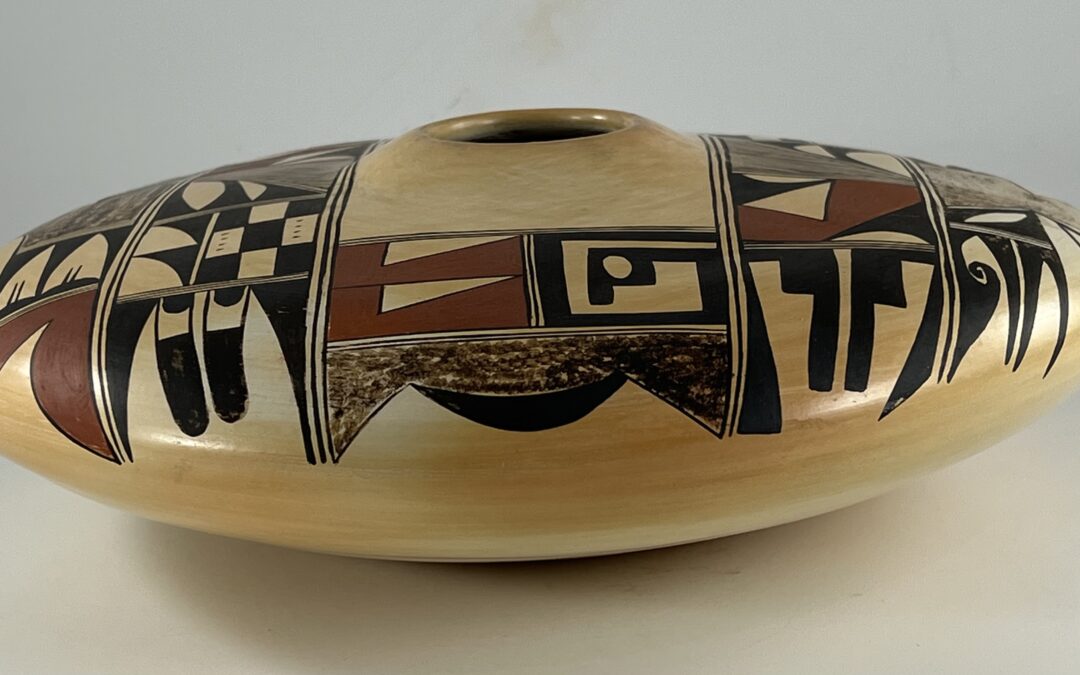

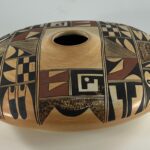
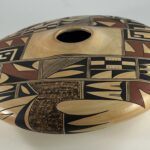


This jar is a masterwork of form, its width 2.962 times greater than its height. Creating such a broad expanse of wet clay over a shallow bowl is extraordinary. Of the 600+ jars in this collection, only 2 have greater width-to-height ratios:
- 2007-11 by Nyla Sahmie with a ratio of 3.854, which cracked during firing.
- 2015-04 by Nampeyo with a ratio of 2.965, a seedjar with a modernist abstract design.
Moreover jar 2025-12 is substantially wider than these two jars, making the wide expanse of wet clay needed to form its top even more remarkable.
The design on jar 2025-12 is an elegant, though standard, mosaic of Sikyatki-Revival elements.
Form:
From a 3-inch wide base the walls of the vessel curve gently upward 3.5-inches and then turn dramatically up to form a 1-inch tall waist. The upper surface of the jar is 4.5-inches wide and is almost flat as it extends to a slight neck surrounding a 1.5-inch opening. On the bottom, a slight impression of the wide puki in which the pot was formed can be seen, with a few slight dimples marking the lower edge of the first coil. Overall, except for that short neck, the pot is almost perfectly discus-shaped.
The jar fired a light tan, with one edge of the jar having a somewhat darker orange color from the outdoor firing. It is signed “Poivee Stella Huma” in large printed letters on the bottom.
Design:
About 0.5-inches from the opening, two 1.5-inch wide strips of design cross the jar’s upper surface (Design 1). Between them is a space 2.6875-inches wide, which forms the width of an unpainted rectangle. Surrounding the mouth of the jar, the rectangle is 4.25-inches long. From the short end of this rectangle to the jar’s waist, on both sides of the opening, there is a patch of large design elements (Design 2). From the outer edge of Design 1 and curving over the rounded waist is a third section of design (Design 3). These three sections of design are separated by 3 parallel lines, “two-lane highways.” Internal to design sections, the elements are separated by 4 parallel lines, three-lane highways. All designs are painted black, except where noted, below. As is typical of pottery from Hopi, the pattern of design on one side of the opening is the same as on the other side, but the sequence of elements reverses. There are about 14 unique patterns of design on the pot.
Design 1
The three-lane highways in this strip of design define five sections. The first and last section depict different avian tails. One section in from the last section is a square birificated into a top and bottom. The bottom is unpainted except for two large right triangles with sloped hypotenuses. Above them are 9 brick forms in three piles, each with a different pattern: a) the middle brick unpainted but sandwiched between two black bricks, b) the middle brick black but sandwiched between two unpainted bricks, each displaying a row of 4 black dots, and c) the same pattern of bricks as “a.” Half of the next section is a large triangle filled with 24 or 26 slanted lines, the number differing between renditions. The next section contains a red element: a red strip with an unpainted, triangular, “bite” taken out of it. This red form is bracketed by large black arrows. This red form is one design section from the end of the strip of designs, which ends with a pair of linear tails.
Design 2
Almost 3-inches wide and 3-inches tall, this section contains only 3 elements. One red section is a somewhat blockier version of the red checkmark seen in Design 1. Next door to it is an unpainted space filled with a black crook defined by four 90-degree angles, its tip displaying 2 steps and an unpainted circle. Below, running the entire width of the design panel, is a stippled form something like the shape of a “W” with the central point a curved hill. This central hill is topped with a black crescent.
Design 3
This design panel is linear on the upper surface of the pot but has a central design that hangs down over the pot’s edge and is abruptly cut off at the lower edge of the waist. At one end of the linear section is a version of the red checkmark we saw earlier, except that the long dimension of the check has a curved surface. Next are two unpaired arrowheads set into a black surface, followed by a large stippled area.
This stippled section narrows and then expands again as it flows over the edge of the jar. One edge of the lower portion is edged by a one-lane highway, which serves as the base of three tall, narrow and conjoint triangles. The opposite edge of this segment is slightly curved and arcing over it is a black crescent, leaving an unpainted crescent below. From the upper edge of the black crescent sprouts a thin line that forms a crook with a triangular end.
Returning to the linear section above, next to the stippled form is a small black space with a lens-shaped unpainted element at its center. The final design in this sequence is complicated. Towards the edge of the jar two fingers emerge from a common base. Above them Is a somewhat similar form, its lower finger linear but the upper extension has morphed into a blade-like form with a curlicue at its rear.
Design Analysis:
One large black crook in Design 2 has a major paint rub and a large speckled area in Design 3 has been lightly erased.
Creating a symmetrical layout of elements and then reversing the direction of the pattern on opposite sides of the jar insures the maximum distribution of red elements. Attracted by these red elements, a viewer’s eyes see the widest expanse of design, unifying what could easily be a frenetic motif. Similarly, all four edges of the pot display spackled designs and these too help integrated the fragmented, busy design layout.
That frenetic look is also calmed by the large rectangle of unpainted space around the mouth of the jar and, to a lesser extent, the unpainted space around the center element in Design 3. See canteen 2024-11 for a similar circular space filled with abstract elements, a smaller amount of empty space and therefore a busier appearance.
In 1986 Stella won “Best of Category” at the Santa Fe Indian Market for a jar very much like this one. I waited for her booth to open to try to buy that jar, but it had already been purchased by one of the judges. Instead, I purchase small seedjar 1986-02. Stella was a warm, engaging woman who took considerable time that day to chat with me between customers.
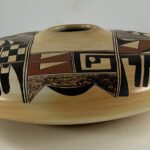
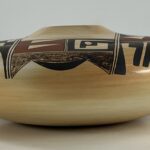
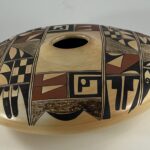
The disk shape of this jar was a feature of ancient Sikyatki pottery and was revived by Nampeyo toward the end of the 19th century. Here that shape is extended to an extreme, as evidenced by a width almost 3 times larger than its height. That ratio is especially striking given the large width of the jar. Sitting on a table jar 2025-13 looks like a flying saucer that has landed. (See photograph 2, above.)
Martians in my driveway would be a disorienting shock.
So is the low profile of this jar.
Ms. Huma was born on September 21, 1929 and died on March 25, 1995.
