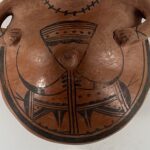
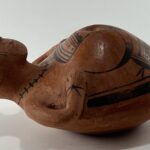
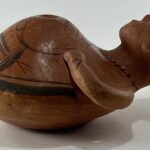
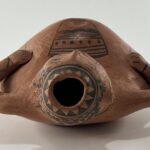
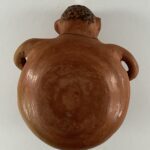
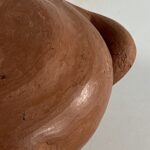
The round body is 5.3125” wide.
From bellybutton to back is 3.25”.
Figural jars from Hopi are rare, but this collection contains two by Nampeyo (2007-16 and 2013-14). Hopi figural canteens depicting humans are even rarer; I have only seen one other example, also by Nampeyo (Streuver, 201:28), pictured below.
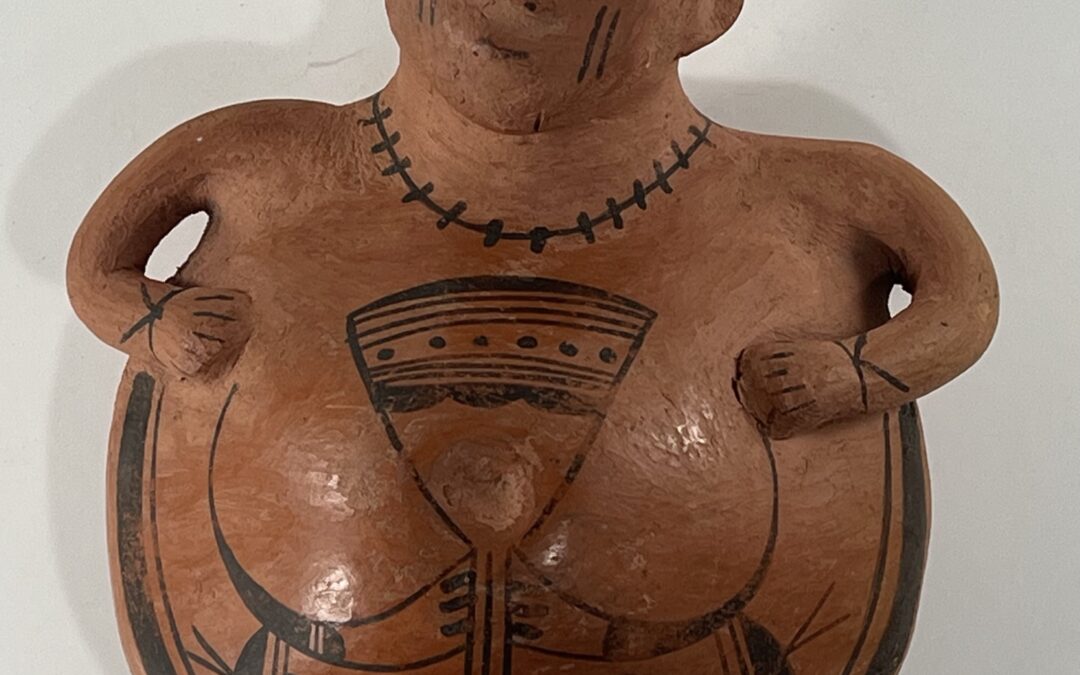
Canteen 2025-14 is defined by robust assertions of both form and design. Together they give this personage an engaging personality.
Form:
The front of the body is conical, occupying about 62% of the depth of the figure, and topped with a dimple bellybutton. The back is formed from a simple dish with a 3.75-inch-wide puki impression that is unusually prominent. The head and neck are hollow and seem to have been attached to the edge of the back dish before the conical front was built. The shoulders might also be hollow, though I cannot quite get an angle to see this clearly. They also emerge from the edge of the dish. Canteens from Hopi generally have loop handles and here the arms with bent elbows occupy that position, though they are only lightly-attached to the body at the wrists and hands.
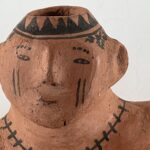
The head of canteen 2025-14 is turned slightly to the viewer’s left. The nose, eyebrows, mouth and ears are appliqué.
The body of this pot is made from yellow “sikyatska” clay that fires red; it is not just sikyatska slipped. Since the yellow clay is difficult to work, this is unusual. As is typical, the expanse of the circular body has been sanded with a piece of soft sandstone to a smooth surface and then polished with a smooth stone. However the upper portion of the canteen is figural and thus full of irregular surfaces that prevent sanding or polishing. Thus on one pot we have both finished and unfinished sections.
Design:
All of the design is done with black paint.
The opening is decorated with a fringe of 14 conjoint isosceles triangles. A fraction of an inch below this array is a thin framing line. Starting just over the ears, and filling the rear of the head, is a patch of stippling representing hair. The nose is about 0.75-inches long with two black dots representing nostrils. A slight ridge curves from either side of the nose and these ridges are painted with 4 dots representing eyebrows. The eyes are lens-shaped with a single black dot indicating the pupils. The mouth is a short, raised, ridge topped with a single thin line of paint. Each cheek carries a set of two parallel lines.
Around her (?) neck is a necklace displaying 15 elements, presumably nuggets of turquoise. Each wrist displays a bracelet consisting of an encircling line bisected by a “V” shape. The hands are marked by 5 short lines representing fingers.
From one arm to the other along the lower edge of the body are a thin-over-thick framing lines. Below the necklace and above the framing lines is a pattern of decoration. Starting at the bellybutton and expanding upward is a large “V”-shaped element about 2-inches on a side. The top edge is an elongated low crescent. Under it are three parallel lines so that together these four elements form a “three-lane highway.” Below this highway is 0.875-inch wide unpaired space housing six large and clearly-defined black dots. Below them are three additional parallel lines followed by a band of three inverted black hills, so that together these four elements form a second “three-lane highway.”
Below the indented bellybutton extending to the lower framing lines are three vertical lines forming a “two-lane highway.” The same pattern of design elements is painted on either side of this highway.
Emerging from the top 0.5-inch of this highway are two crescent black “wings” very much like those found on Nampeyo’s Sikyatki Revival “eagle tail” pots (cf 2005-16). The base of these wings is unpainted, but Nampeyo has added three stubby parallel lines that emerge from the edge of the base into this space. Note that the left rendition of the empty space is 67% larger than the right rendition (1.25-inches vers 0.75-inches).
The area between these wings and the framing lines below is filled with a design whose vertical outer edges are “two-lane highways.” Affixed to the outer edge of these highways are large black “gumdrop hills with whiskers.” In two parts, growing from the central vertical two-lane highway to the edging two-lane highways, is another horizontal two-lane highway. Thus the design below the wings is divided into “upper” and “lower” sections, though [as noted above] the design in each of the horizontal pairs is the same.
The upper section is largely unpainted except that a) each side contains three large and clearly-defined black dots, although the rendition to the right is larger and the dots spaced more evenly that the rendition to the left, and b) along the lower edge of this space is a fringe of small black hills, 6 on the left side and 7 on the right side. The design in the lower section is more complicated. Near the central upper corner of this space is a design consisting of two inverted right triangles with curved hypotenuses set parallel to each other, and downward-pointing. From the outer corner of this form to the lower outer corner of each side is a thick black stripe over two parallel lines, resulting in a two-lane highway. Above this diagonal are more large black dots, 3 in the right rendition and 2 in the left. The remainder of this lower section is unpainted, except for more large black dots along the thin lower framing line, 4 dots on each side except that one of the dots in each panel was applies so quickly that it became a short line.
The lower section of design is roughly in the form of a compact square, but off either end of this square is substantial empty space. From the curved black wings up to the opening a good deal of the surface of the pot is unpainted.
Design Analysis:
The sequence of construction employed on canteen 2025-14 (adding figural elements to the edge of a dish and then building the form up from this point) was used by Jean Sahme Nampeyo 5 generations after Nampeyo to build avian effigy pot 2025-03.
The nose, eyes, eyebrows and ears on canteen 2025-14 were formed and painted very much like those same features on effigy pot 2007-16 by Nampeyo. On both the nose is prominent and sloped with thin ridges continuing to form slightly-raised eyebrows. On both the eyes are lens-shaped with a simple dot for the pupil and the ears are realistic. The faces on effigy pot 2007-16 and canteen 2025-14 both carry markings on the cheeks, though these markings are different. The only other examples in this collection of figures with two stripes on each cheek are on effigy jar 2017-01 by Nampeyo.
The slight turning of the head to the viewer’s left throws the form of canteen 2025-14 off-balance and gives this personage a life-like and energized visage. She (?) seems to be listening. This is a friendly person I’d like to get to know. Her protruding belly suggests she might be pregnant. The contrast between the rough surface of the neck, head and arms and the polished body also adds interest.
The large “V” on her chest is reflected in the small V-elements on her bracelets. In 5 locations Nampeyo drew a series of large, black dots. Similarly, a fringe of black hills appears in the upper fan shape and also in the design below the black eagle tails. These repetitions unify the design. The 3 stubby lines painted at the base of the black curved wings echo the five lines just above on the appliqué hands, linking different formats of design. Note, however, that the 5 lines marking the fingers demarcate the hands into 6 sections, an inaccurate portrait by a fine artist without much experience depicting hands.
The black hills with whiskers that edge the lower design panel are a frequent Nampeyo motif. [See “Appendix F” and “Gumdrop hill with whiskers.”]
A reader of this website knows that I have developed six design strategies that I think typify Nampeyo’s Sikyatki Revival pottery. These strategies are not used by her on every pot; they are simply available in her aesthetic toolbox. However, the more of these design techniques I see on a pot, the more confident I am that Nampeyo designed the pot. These criteria emerge from studying Nampeyo’s Sikyatki Revival pottery made late in her career for sale to the Anglo world. Canteen 2025-14 is such a pot and applying these design criteria might be informative. The six strategies are:
1) A tension between linear and curvilinear elements, often represented as a contrast between heavy and delicate elements.
The sides of the large “V” are linear, as are the 8 “highways” on the canteen. These visually contrast with the two sweeping curvilinear black wings.
2) A deliberate asymmetry of design.
The head titled to the viewer’s left throws the canteen’s form off symmetry. Below the curved wings there are fringes of hills, 7 hills on the right and 6 to the left. The lower section of the bottom square of design has a diagonal of design in an upper corner. Above the right diagonal are 3 black dots. Above the left diagonal are 2 such dots. These are just the kind of minor asymmetries that are typical of Nampeyo.
3) The use of color to integrate design elements.
Since all of the design is in black paint, this criteria does not apply. However, the black dots Nampeyo draws in 5 areas of her design serve much the same function.
4) The use of empty (negative) space to frame the painted image.
The square of design elements on the lower portion of the design has substantial empty space off each end. The elements above this area [eagle-tails, V-fan, necklace and face] are surrounded by empty space to an even greater degree.
5) The use of a thick above a thin framing line on the interior rim of her bowls.
Nampeyo’s canteens are decorated as if they were convex bowls, thus showing framing lines in reverse order. Canteen 2025-14 has the expected farming lines, except where the figurative form interrupts the circular body.
6) Nampeyo’s painting is confident, bold, and somewhat impulsive compared to the more-studied, plotted and careful style of her daughters, descendants and other Hopi and Hopi-Tewa potters.
As usual, we will consider each of these dimensions in order:
Confident:
Nampeyo formed many small circular canteens for sale (cf. 1999-03, 2010-11), but forming a small canteen with a figural head requires an increased level of confidence to shape the form. Turning the head slightly off-center seems deliberate and a measure of Nampeyo’s confidence in the effect. The curved eagle tail “feathers” transform from thick to thin as they approach their tips, but these elements are done smoothly, without apparently repositioning a yucca-leaf brush. The ability to draw great curved elements smoothly is typical of Nampeyo’s confident work.
Bold:
Simply attempting a figural canteen, a form that is not indigenous to Hopi, requires some boldness. The sharply conical torso with the prominent bellybutton is a bold form. The large “V” shape on her chest is dramatic and bold, as is placing two sweeping eagle tails in the limited space below the “V.”
Somewhat Impulsive:
The form of canteen 2025-14 is so unusual for a pot from Hopi that it must have been thoughtfully constructed. Overall the design on canteen 2025-14 is symmetrical and balanced. However, the unpainted base of the left wing is 67% larger than the base of the right wing. Just below the curved wings the three dots to the right are larger and better-spaced than the three smaller dots to the left. Below them there are fringes of hills, 7 to the right and 6 to the left. At the very bottom of the design, touching the thin framing line, are a series of dots, but on both sides there are dots that became lines because they were hastily applied. These deviations are indications of impulsivity.
In short, a review of Nampeyo’s Sikyatki Revival design strategies support the conclusion that she made this figural canteen.
On 1-26-26 I had a chance to speak with Ed Wade about this canteen. He agrees that this canteen is by Nampeyo:
“In the first instance, both the color and form of your canteen are modeled upon those made by the Seven Tribes [Maricopa, Pima, Yuma, Mojave, Pi-Posh, +]. She [Nampeyo] likely saw such canteens during her time at Hopi House in 1905 and 1907.
Marti [Streuver] had several figural pots for sale (like 2007-16 and 2013-14) and these have the same coffee-bean eyes, sharp nose and tilted head we see on your canteen. The loped arms are also characteristic of the handles on the Streuver canteen. (See below.) Nampeyo was a good figurative sculptor.
Without question the painting and form are her style.
The large triangular form on the chest with its dark-banded edge is a motif she used that is derived from San Bernadino ceramics. The black hills with the V lines (“hills with whiskers”) are a common motif of hers.
The inverted rain bird curves are perfectly-drawn and are a mark of her work.
The whole design has a perfected used of [empty] space, which is characteristic of her.
Its hers. No question about it.”
The only other human-figural canteen from Hopi that I know of was also made by Nampeyo and for a number of years was the most expensive Nampeyo pot for sale by the Andrea Fisher Gallery, Santa Fe. This is the canteen that Ed Wade referred to (above). A photograph of it was published in Struever, 2001:28: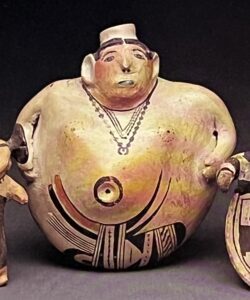
Notice that the bulbous person on this canteen stares straight ahead, his (?) hands on his hips making the person seem rather demanding. The face seems more detailed than on my canteen, but overall similar. The positioning of the arms and the prominent bellybutton are very similar to canteen 2025-14.
At the end of our 1-26-26 telephone conversation, I asked Ed Wade if he had seen other figural canteens by Nampeyo. Other than the Strteuver canteen, he said “No,” but added “I’m sure there are others out there.”
The Cooke Collection at the Museum of the West in Scottsdale contains a figural canteen by Nampeyo that features a bear head:
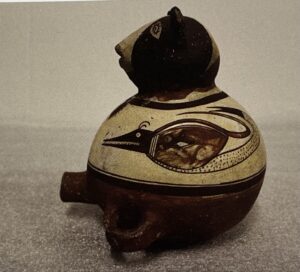
Wade and Cooke, 2022:112
This is certainly an eccentric pot, but demonstrates Nampeyo’s imagination and willingness to experiment and well as her virtuosity in molding clay.
One other set of figural pieces by Nampeyo is known. Barbara Kramer publishes (1996:158) a photograph of four “Rain Gods” made in the tradition of Tesque Pueblo and bought at Tom Pavatea’s trading post on April 12, 1922:
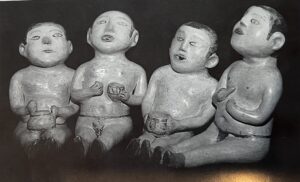
Photo by Gary N. Meek, MD
Tom Pavatea was Nampeyo’s brother and apparently these figurines were sold as having been made by Nampeyo. However Nampeyo was functionally blind by 1922 and the Blairs reasonable conclude that Nampeyo likely did not paint the figures (Blairs, 1999: 119). The Blairs report that a 1984 National Park Service pamphlet reported that the four figurines were ordered by the owner of the “Quapaw Bath House” in Hot Springs, Arkansas, presumably to give his establishment an “authentic Indian” mystique. Kramer notes that they are now owned by the grandson of the man who purchased them.
Canteen 2025-14 and jar 2025-13 by Nampeyo were purchased on the same day. Together they represent the entire range of Nampeyo’s work. Jar 2025-13 was made by the younger Nampeyo for domestic use without regard to the marketplace. Canteen 2025-14 is exactly the opposite: made by an older Nampeyo entirely to appeal to a tourist’s desire for a “real Indian” artifact. Both –differently– add to our understanding of the range of work achieved by Nampeyo.
