
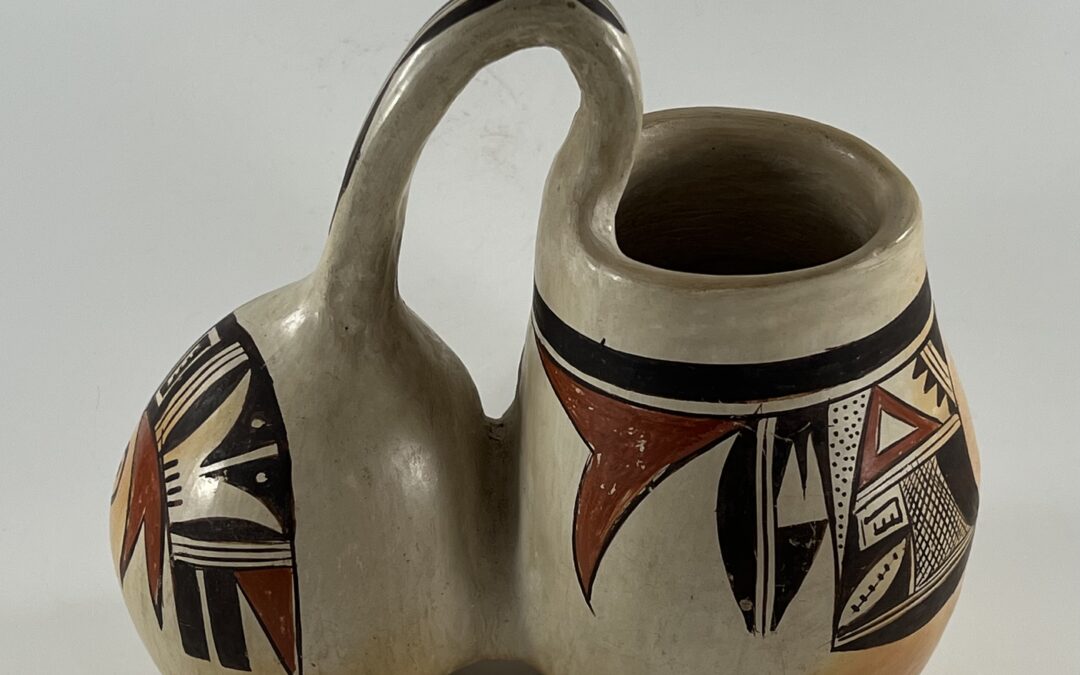
Large lobe: 5.0” h X 3.875 “ w
Small lobe: 4.0625” h X 3.375” w
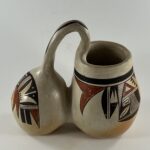
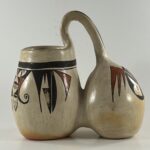
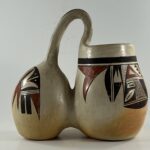
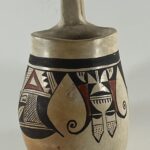
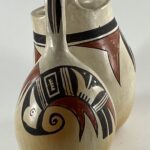
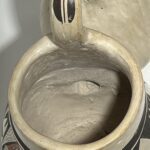
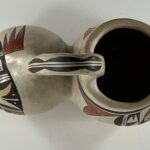
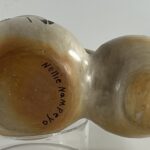
Bi-lobed canteens are a tradition at Acoma Pueblo, just west of Santa Fe, and are less-frequently made at a number of the Rio Grande pueblos. This form is not native to Hopi and is rarely made there. Nevertheless, this collection includes two other examples of bi-modal canteens from Hopi in addition to 2026-01. Each of the three examples has its own unique shape. See 2022-03 by Jean Sahmie and 2024-02 by Nampeyo.
The shape of canteen 2026-01 is compelling, but the walls are unusually-thick and the painting on the large lob appears disorganized. Nellie created finer pottery (cf 2010-04 and 2024-05), but the cruder form of this double-lobed canteen and the indifferent painting are also typical of her work (cf 1991-03).
Form:
The large open lobe: The walls of this lobe are about 0.25-inches thick, which I assume is the general thickness of the vessel. As a result, the pot is quite heavy for its size. The bottom is a 2.5-inch-wide disk. From this bottom the walls slope slightly outwards 2-inches to the waist and then slightly inwards 2-inches to a vertical 1-inch neck surrounding a 2.5-inch mouth. The lobe is not symmetrical: the side facing the second lobe is fairly flat compared to the inward slope of the end of the canteen. The inside of the neck has been somewhat stone polished, but the lower surface of the interior has only been scraped fairly smooth.
The smaller closed lobe: The bottom is a 1.8125-inch-wide disk. This lobe also is not symmetrical: the inward face of the lobe seems to have a fairly constant slope above and below the waist, while the surface of the end of the canteen slopes outward 2.25-inches from the base to the waist and then slopes more sharply inward to the handle.
The exterior surfaces of both lobes were fully polished with a smooth stone. The polishing left only faint striations.
The two lobes are attached by a bridge of clay about 0.25-inches wide at the top and 0.6875-inches wide at the bottom, the variance due to the slope of the lobes near their base. The bridge is 2.0-inches tall, about half the height of the small lobe. The lower half the this bridge, where it is the widest, has been polished. Above this section, where the gap is narrow, the bridge remains unpolished. Inside the larger lobe a 0.75-inch-wide hole can be seen running between the two lobes.
Uncurled the handle would be about 6-inches long. It is in the form of an inverted “J,” with the short side rising vertically from the edge of the open lobe and then angling downward to the top of the closed lobe. It is fully-polished.
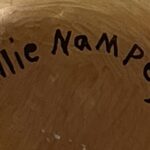
The bottom and ends of the vessel are blushed golden from particularly hot exposure to the outdoor dung firing. In clear printed letters on the bottom of the larger lobe is the signature “Nellie Nampeyo.”
Design:
The large open lobe:
A thick black framing line encircles the neck. Just below it is a thin framing line and the design is pendant from this lower line. This lobe has three sections of design that form an almost continuous band, but they are not placed symmetrically on the lobe. From the perspective of the end of the lobe, I label the far left design as “Design 1,” the central design as “Design 2,” and the right-most design as “Design 3.” All of the design is black except where I note a red element.
Design 1 begins on the right with a red pointed element somewhat in the form of a shark’s tooth. The right-most point of this form wraps around the lobe until it is almost under the handle. Moving to the right, next is a long thin hill shape, hung vertically and separated from the nest element by three parallel lines, a “two-lane highway.” The next form is similar to an upside-down “W” with a right triangle bridging its points.
Next is a somewhat square cluster of about a dozen elements. The upper left corner of this square is an unpainted, downward-pointing triangle incorporating 4 rows of 4 dots, 3 rows of 3 dots and 8 single dots as the form narrows to a point. To its right is a red isosceles triangle with an unpainted triangle at its center. Continuing right is an unpainted space, its right side a band of four small black isosceles triangles, creating a residual unpainted saw tooth and thus foreground/background reversal. The upper right corner of this square section is triangular, its base a three-lane highway and its point a black triangle. Below this upper section is a two-lane highway; the immediate space below it is organized into three vertical sections. The left section displays an unpainted square enclosing a black crook ending in three vertical lines. Below is an unpainted lens shape enclosing 6 black dots strung along a black line, like a beaded necklace. The middle section is almost in the shape of an unpainted rectangle, except that its right edge is a curve. It is crosshatched by 21 left-sloping lines and 12 almost-vertical right sloping lines. The first set of lines is more-carefully-drawn than the second. A one-lane highway forms the lower boundary of this crosshatched section. To the right is a curved tooth-like form. Below, and running across the entire width of this cluster of designs is a two-lane highway. Below it is another half-moon hill shape with its flat upper side bounded by the highway above.
Design 2 is the most coherent of the three design patterns on this lobe, an elaboration of Nampeyo’s “eagle-tail” design. The left and right flanking elements are curvilinear “wings” outlined in black paint. Their black bases incorporated an unpainted tooth shape displaying two short vertical lines. The middle section of the wings is red, caped by black curlicues ending in small round balls.
Between the wings is a rectangular section occupying about 60% of the design space and below it are two pendant feathers. This rectangular section can itself be seen as a small horizontal rectangular section sitting atop a larger vertical rectangular section.
The smaller top horizontal rectangle is divided by a central, vertical two-lane highway. The designs flanking the highway are mirror images of each other. Adjacent to the highway are small, black, right triangles, pointing down with curved hypothenuses. The residual space in this rectangle is unpainted, thus forming upward-pointing right triangles with curved hypotenuses. The larger vertical rectangular section below has the same small black right triangles with curved hypotenuses in each of its four corners. The result is an unpainted lens at the center of this space. Floating at its midpoint is a black hill form based on a two-lane highway. Pendant from the highway are 7 short and parallel lines.
The two pendant feathers below are comparitively simple. Their base is a small crescent hill, followed by an unpainted section and caped by unpainted points displaying dots. The right arrow has 24 such dots and the left 27 dots. The left tip with 27 dots is more patterned into rows than the right arrow.
Design 3 is the simplest pattern on the large lobe. There are black and red designs. The black design is a collection of elements. From left to right these are: a large pendant isosceles triangle pointing down, a tiny isosceles triangle also pointing down, a pointed form (again pointing down) resembling a knife with handle and blade, and another long hill shape, its flat side parallel to the knife. Finally there is a red triangular form hanging by a corner from the black design. The base of this triangle is concave.
The smaller closed lobe:
This lobe displays a typical Hopi design, probably a hummingbird with a crest. At the center of the large black head is an irregular unpainted form with a dot-in-circle eye. The lower corner extends to form a proboscis ending in a curlicue. Behind the head four parallel lines form a three-lane highway, a design field and then a second three-lane highway. The area between these “highways” is edged by a rectangle and floating inside this rectangle is a second, smaller rectangle. Sprouting from the right wall of the smaller triangle are 4 short parallel lines. The next section of design is dominated by an unpainted crown-shaped element with two points. Between these points rises a thin, unpainted strip. The crown is embedded in a black background which, on either side of the vertical strip, is punctuated by small unpainted dots. Intruding into the unpainted space at the base of the crown is a set of four parallel lines. After another three-lane highway, the tail is formed by a red right-angle triangle with a curved hypothenuse above two solid-black rectangular feathers. Above the head is a red crest formed by a gradation of conjoint isosceles triangles. Below the belly of the bird is a curved red form with the right end a single point and its left end displaying two points.
The handle:
On its upper surface is a design consisting of a single line, on either side of which is a series of three conjoint hills. The two hills on the long slope of the handle are long; the hill on the short slope is short.
Design Analysis:
Mary and Laurence Blair, write of Nellie that:
“[S]he never aspired to become a famous potter herself. Compared to her sisters, her output was low and her noninnovative decoration did not have the sophistication that theirs did. Although she had the ability, she seemed to lack the necessary interest (1999:203).”
Canteen bank 2024-05 by Nellie would seem to be an exception to this observation. Given the rarity of bi-lobed canteens from Hopi, one could argue that the shape of 2026-01 makes it another exception, but the Blair’s comment is relevant to both the form and decoration of canteen 2026-01.
On the positive side, considerable planning is evident. The asymmetry of each of the two lobes was carefully planned so that each presents a more vertical face to be joined by the bridge. The polishing of the entire surface of the lobes was finished before the lobes were joined, since there is no room for a polishing stone between the lobes. Once the bridge was added and dried, Nellie polished its accessible bottom, a second carefully-planned polishing effort. The shape of canteen 2026-01 is far more difficult to form than the standard bowls and jars. Nellie made a substantial commitment of time and effort forming this vessel. There is a lot of intricate painting on the vessel, particularly the larger lobe. Visually the painting seems a bit frenetic, but it required detailed work. Both the form and design of canteen 2026-01 are evidence that Nellie was making an unusual effort. The production of canteen 2026-01 was not casual.
Several design strategies are evident in the painting. Three large, 1 medium and 2 small crescent elements are incorporated into the design of the large lobe. A variety of related triangular shapes are incorporated into the design of both lobes, creating foreground/background reversal which energizes the decoration. Thin, hill shapes occur 12 times in the design across both lobes and the handle. In just the core of the eagle-tail design there are 8 triangles with curved hypotheses. The red element below the avian form on the smaller lobe displays two points on its left end, reflecting the pointed red feather in the tail immediately above. Red elements on both lobes encourage a viewer to see the range of decoration. These 6 strategies help integrate the canteen’s design.
Nevertheless, canteen 2026-01 has a less graceful shape than the other examples from Hopi, pictured below. The decision to place the two lobes close together constrained both the form and finishing of the canteen. The shape forces handle into an awkward “J” shape and the connecting bridge squashed between the lobes had to be left partially unpolished. If the lobes had been placed further apart, as is true of all the other Hopi examples, the handle could have been gracefully-symmetrical and the entire tube connecting the lobes could have been polished. As is, the handle is slightly off-kilter to the rest of the vessel, as can be seen photographs of the end views, #4 and #5 above.
On the large lobe, “Design 1” is just a mosaics of elements without an overall pattern, as if throwing more vegetables into the pot would make the stew better. Th eagle tail of “Design 2″ has the format of this well-known design, but the central core is unusual and quite busy. Finally, the few elements that define “Design 3” on this lobe form no coherent pattern. The typical Hopi hummingbird design on the smaller lobe is more coherent and focused than the painting on the larger lobe.
There is revealing pattern in the details of design. Note that a) the unpainted triangle on the larger lobe has its 33 dots carefully arranged in rows, b) the nearby crosshatched section has one set of 21 lines carefully drawn crossed by 12 casually-drawn lines and c) the right feather tip in the eagle-tail design with its 27 dots is carefully-patterned while the 24 dots in the tip of the right arrow are casually-placed. In short, Nellie could do careful work but often chose not to do so. Perhaps she drew the careful placed elements first and then lost patience.
I only know of five other bi-lobed canteens from Hopi with roughly the same shape as 2026-01 and three of these are only known from historic photographs.
Given the rarity of bi-modal canteens from Hopi, it is surprising that these photographs are of Nampeyo. An 1893 photograph of Nampeyo and her Mother displays their pottery, including a double-lobed canteen with the spout on the connecting bridge. See the catalog entry of pot 2022-03 for this image.
The second photograph is in the collection of the Museum of Northern Arizona, catalog # MS-240-3-442 and was taken by Emory Kopta ca 1920. It shows Nampeyo sitting among several pots. On the ground to the viewer’s left is a double-lobed canteen much like 2026-01. A second double-lobed canteen can be seen nestled between pots on the right side of the photograph:
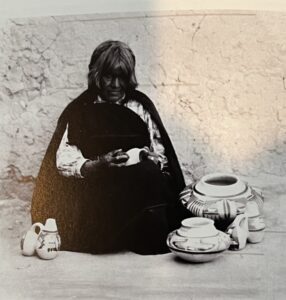
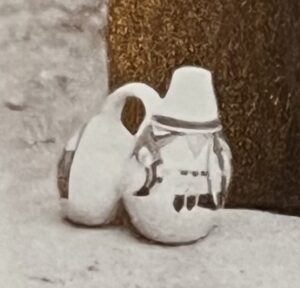
From the composition of the photograph the displayed pots are certainly being presented as “by Nampeyo.” However Nampeyo was functionally blind by about 1915. While she continued to form pots, female relatives painted for her after this time. [See Appendix E for a discussion of this collaboration.] Thus Nampeyo might have formed the bi-lobed canteens shown in the Kopta photo, but likely she did not paint them. Note that the handles of the two canteens in this photograph are symmetrical and gracefully-applied when compared to the handle on canteen 2026-01. The location of these two canteens, if they still exist, is unknown.
The Hanging Tree Gallery (Albuquerque) owned a bi-lobed canteen and it is shown in the Blairs’ book about Nampeyo . They note it is a “crude copy of a prehistoric shape” and is signed as formed by Nampeyo and painted by Fannie (1999:176). Note that both the handle and connecting bridge are more graceful than canteen 2026-01:
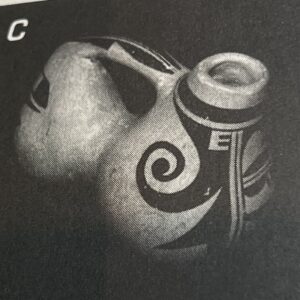
L Blair, photographer, 5 by 7 inches
Finally a miniature bi-lobed canteen was offered for sale by Adobe Gallery in Santa Fe. Owner Al Alexander lists several new items every day, often pottery. During the 51 years he has been in business he has had only one bi-lobed Hopi canteen. Again, note that both its handle and connecting bridge are more graceful than canteen 2026-01:
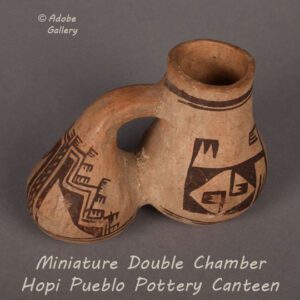
3.0” h X 2.125” w X 4.25” long
Thus canteen 2026-01 is part of a limited tradition of making bi-lobed canteens at Hopi. The difficult shape and intricate painting are evidence of Nellie’s commitment to her craft and willingness to experiment. The heavy, awkward form of the vessel and the crowded, disorganized, painting are evidence of Nellie’s limitations as an artist. Canteen 2026-01 well-represents its maker.
